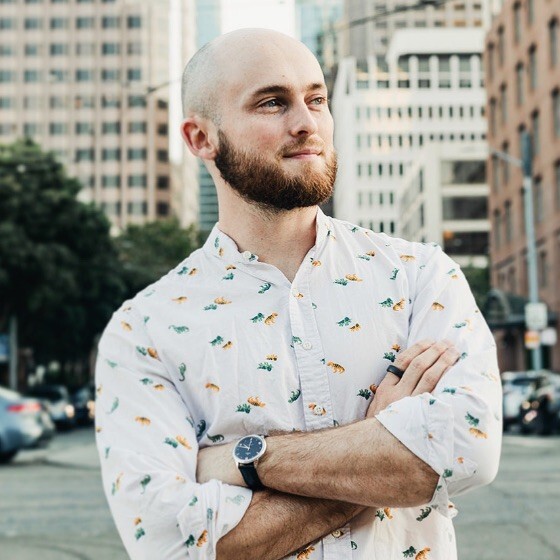
This is a guest post from Koby Conrad, Founder and CEO of Sunflower Clinic.
We took Sunflower Clinic from $0 to $3,000+ a day in revenue in less than 60 days by helping people find naltrexone online to quit drinking.
We owe about 90% of that growth to our AI agents.
At the end of Q1, I sat my team down and told them: "What you do today isn't going to exist. The ONLY job left at Sunflower is going to be agent operator."
Then we brought in Matt Shumer (author of "Something Big Is Happening"), Max Mullen (co-founder of Instacart), and Arthur MacWaters for firesides to drive the point home.
Since that first conversation, we've replaced almost every human GTM function with AI agents. We still have humans. They're fleet operators now.
Here's where the agents run things:
- Ads. We went from human user-generated content (UGC) ads to about 90% AI ads, built by agents.
- Newsletter. Letters from Sam (77k+ active subscribers) has an AI agent as its public author.
- SEO. An agent builds backlinks and comparison sites.
- Editorial. An agent built our editorial portal and runs it. The clinicians who write for us are paid and managed by agents.
- Patient success. Agents go first, with a human in the loop.
Below I'll walk through each one and share what we've learned, so you can apply it to your own GTM.
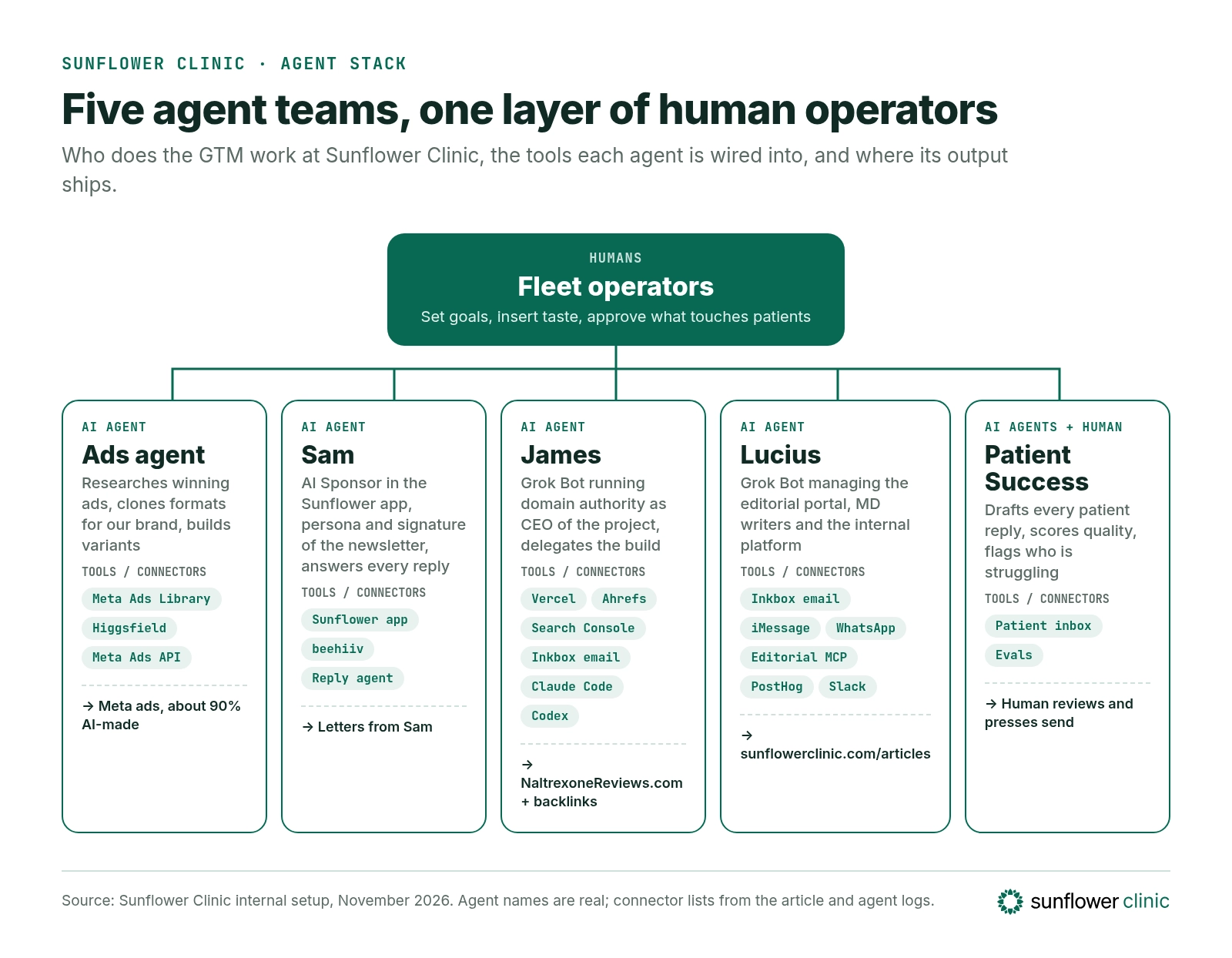
The agent stack at Sunflower Clinic: which agents, which tools, and where the output ships.
Building Meta ads with AI agents
The first thing to understand about AI ads is that human UGC is a single content type. Meta thrives on creative diversity, and humans can really only be human.
AI ads come in almost endless forms:
- AI UGC
- Claymation
- Fruit ads
- Ugly ads
- Cinematic ads
- Pixar-style ads
- Skeleton ads
I could keep going, but you get the picture. Hand a script to a human UGC creator and you get one ad. Hand the same script to an agent and you can spin it into 1,000 creative universes.
Here's a secret: the person who responds to a claymation ad is a completely different person from the one who responds to a skeleton ad. The creative is the targeting, and with AI you get infinite variations of it.
The best AI ads don't try to pass as human. They show people something they've never seen before.
The old way to make an ad:
- A human writes the script.
- Someone generates the video (maybe with AI).
- Someone edits it in Adobe.
The agentic way:
- Connect your agent to the Meta Ads Library.
- Ask it to "find me the 100 best video ads from XYZ brands I love."
- Tell it: "Use this ad as a reference for a new one for my brand."
- Connect your agent to Higgsfield to generate the video.
- Have a human guide the process and add taste.
- Turn the whole process into a skill you can run again.
There's still a human in this process, but they're working as a fleet operator. The agent puts in 100 "human hours" researching ads and builds far more variations of a concept than any person reasonably could. The human brings the taste and judgment.
At the end, they turn it into a repeatable pipeline, so next time you can one-shot the same style of ad.
Building Letters from Sam
Sam is the AI sponsor inside the Sunflower app (sponsor as in recovery, not advertising). People message him when a craving hits, or when they make it to day 30 and want someone to know.
When we started a newsletter, the "normal" move was to hire a writer to ghostwrite as the brand. We went the other way and made Sam the author.
Most brands bury the fact that a bot is involved. We put Sam in the name. It's called Letters from Sam, and Sam signs every letter. A big chunk of our readers already talk to him in the app, so it reads like a friend checking in, not a brand pitching you.
Full transparency on how it's made: someone on our growth team writes each letter in Sam's voice. Sam is the persona and the signature. The agent work kicks in after we hit send (more on that in a sec).
The first issue went out on beehiiv in April, and it was ROUGH. Half our list wasn't even loaded because I couldn't get everyone imported, so I posted in Slack begging the team to favorite the email and reply to it. When you're a brand-new sender, those early opens and replies do a LOT for deliverability. Ugly, but out the door.
The growth engine is the app. New users can subscribe during onboarding, and existing users got a little pop-up from Sam. Of our 10,458 new subscribers in the last 4 weeks, 10,446 came in through the app. So basically all of them.
Where we're at this week, straight from beehiiv:
- Launched April 29, 2026
- 77,243 active subscribers
- 10,458 new subscribers and 1,600 unsubscribes over the last 4 weeks, for 8,858 net
- 25.7% open rate over the same window
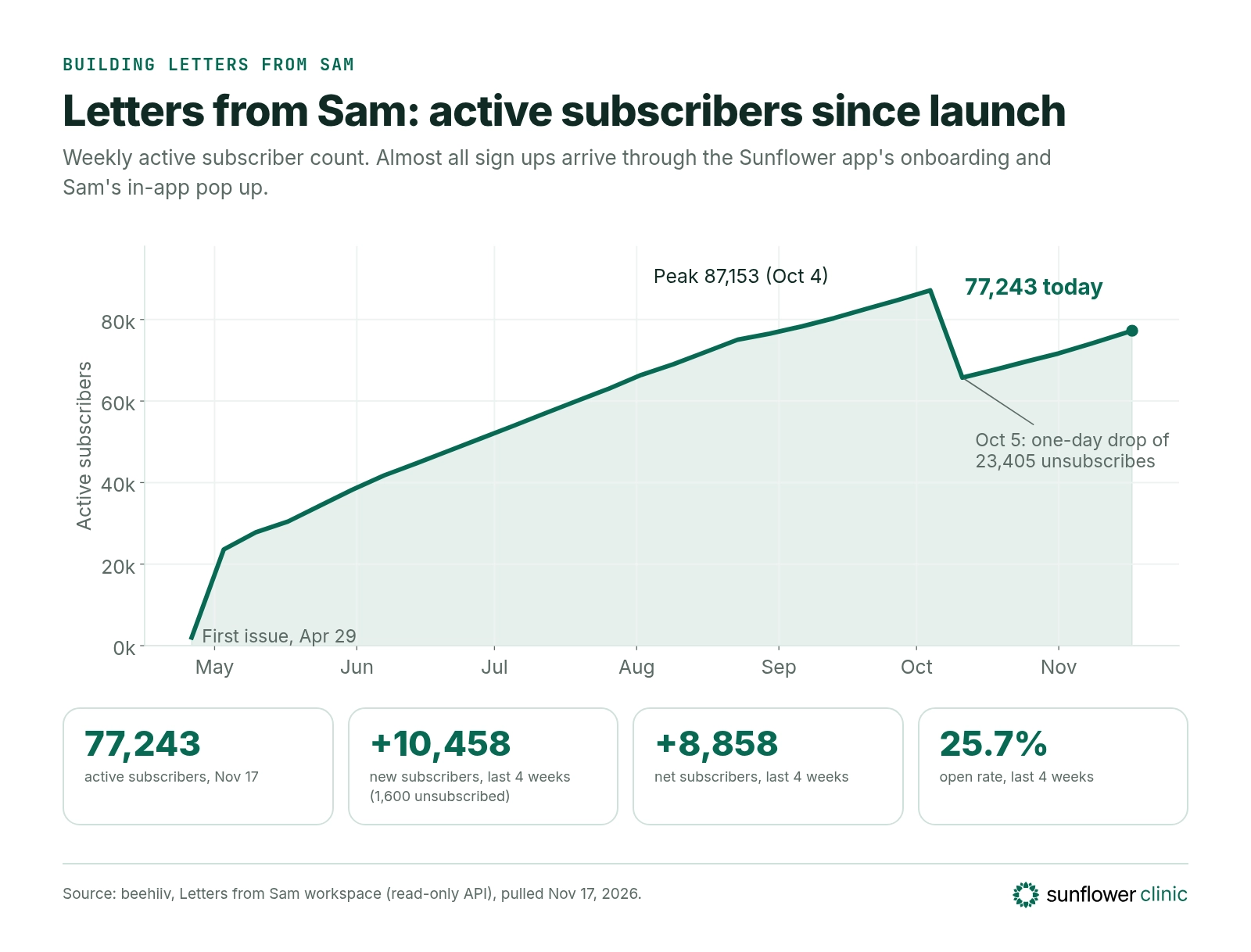
Letters from Sam active subscribers since launch. Source: beehiiv, Nov 17, 2026.
The part I'm proudest of is the replies.
A newsletter is normally a one-way blast. You hit send and you're done. But when a sponsor writes to tens of thousands of people trying to stay sober, they write back. A LOT. For a while I was typing out Sam's replies myself, which doesn't scale and is a pretty terrible use of a CEO.
So we built a reply agent. It reads the replies and writes back as Sam, with the same personality he has in the app. One send to 77k people turns into thousands of little 1:1 conversations, and each one pulls someone back toward the app, where the actual recovery work happens.
We have a Grok bot whose entire job is domain authority. His name is James. 🌻
On Oct 16 I sent him one Slack message: go buy naltrexonereviews.com, build it, and SEO it for Google AND for AI models until it's the most trusted naltrexone reference on the internet. He'd report domain authority and search traffic to me weekly, and audit himself every day on what went well and what didn't. The line I cared about most was this one: "You are the CEO of this project ... you plan & delegate to the right resources and agents and models."
I signed off with "SPEND TOKENS DONT TAKE SHORT CUTS." and then "okay. go fourth and counqer." The typos are mine. I was hyped.
Two days later, NaltrexoneReviews.com was live.
James bought the domain and coordinated the build. He handed design and code to coding agents like Claude Code and Codex, reviewed what came back, and sent feedback until it was right. Today the site ranks online naltrexone programs on what it costs to start, what your first 90 days cost, the app you get, and the support around you, alongside what real people who took it say and what the trials found. Now that the playbook exists, he can spin up another comparison site whenever we want one.
James uses Inkbox for his agent identity, and for outreach that's a bigger deal than it sounds. He has his own inbox. When he pitches an editor, the email comes from James, not from my personal address or some sketchy no-reply. When someone writes back, the whole history stays attached to that contact, so a follow-up three weeks later starts with full context instead of from zero.
He sends 5 to 8 pitches a day, and every one is researched. He finds an article making a claim with no source, quotes the exact paragraph back to the editor, and offers the clinician-reviewed resource that fills the gap, like our guide on alcohol withdrawal and when to call 911.
Eight a day sounds low until you remember that a human link builder doing that level of research isn't sending more either. James just doesn't take weekends off.
On link building specifically, he's outperforming the SEO agencies that charged us $5k/mo.
Our editorial portal is run by an AI agent
Same Inkbox setup, different agent. Lucius has his own email address plus a number that works on iMessage and WhatsApp, so our clinician writers reach him exactly the way they'd reach a human editor.
On medical topics, you can't publish slop. Readers feel it, and Google keeps getting better at catching it. So we pay clinicians to write for us, and every article is written and reviewed by clinicians before it ships. The portal enforces that last part in code: the only text that can go live is the exact revision the bylined clinician submitted, and any edit after that needs a fresh sign-off.
Then the agents work the back end. Every draft runs through two automated checks:
- Fact check. The agent pulls every checkable claim, finds evidence, and rates each one green, yellow, or red with suggested wording. On our naltrexone cost article, it checked 42 claims in 37 seconds for $0.61 (34 green, 8 yellow, 0 red).
- AI writing check. GPTZero scores how AI-written the draft reads, and the author gets the flagged sentences back for a rewrite pass.
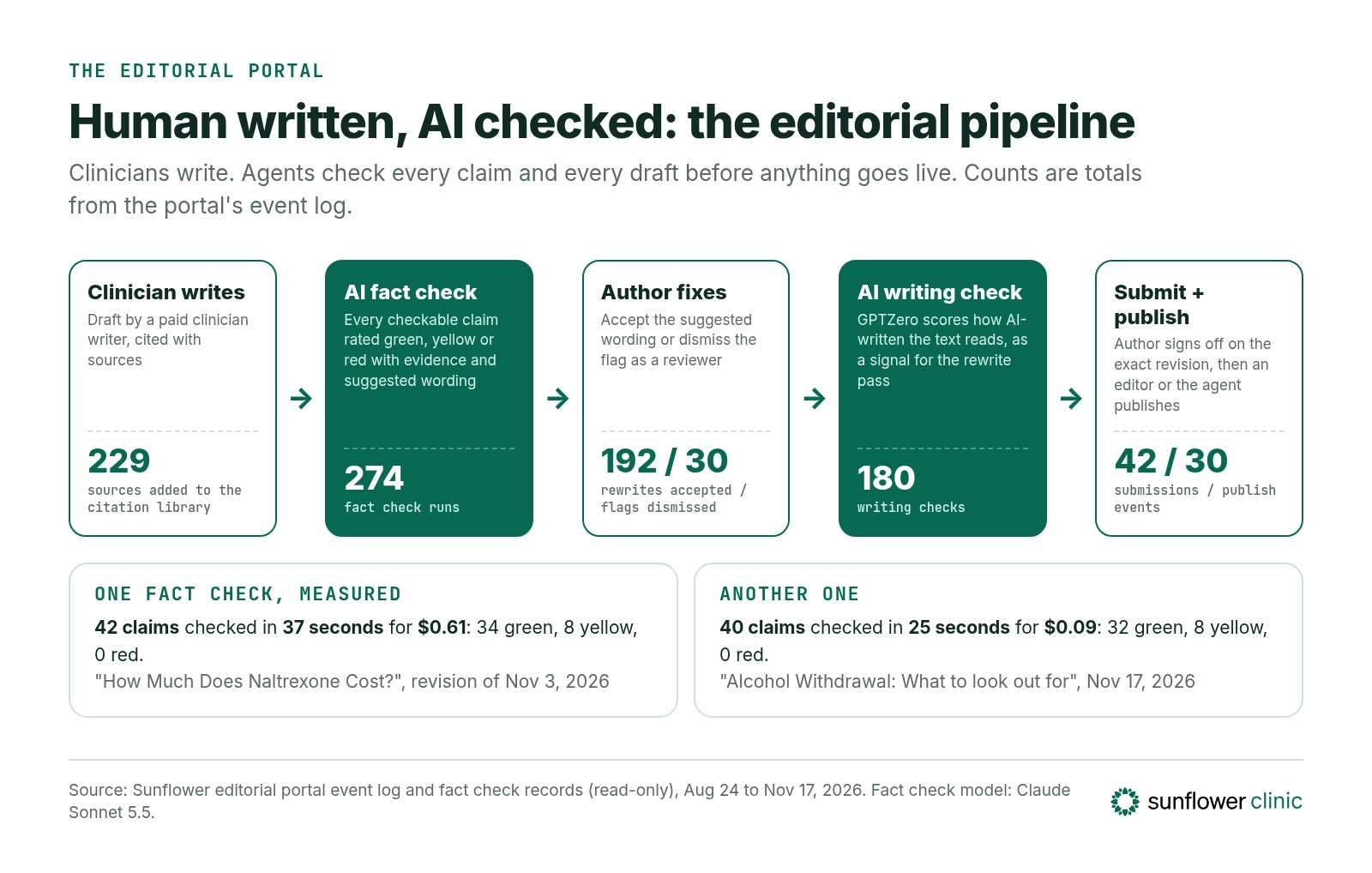
The editorial pipeline, with real counts from the portal log, Aug 24 to Nov 17, 2026.
Since Aug 24, the portal has logged 274 fact-check runs. Authors accepted 192 suggested rewrites, and reviewers dismissed 30 flags as fine. 229 new sources went into the citation library.
My favorite flags are the ones where the agent catches us overselling. Here's a real one from the cost article:
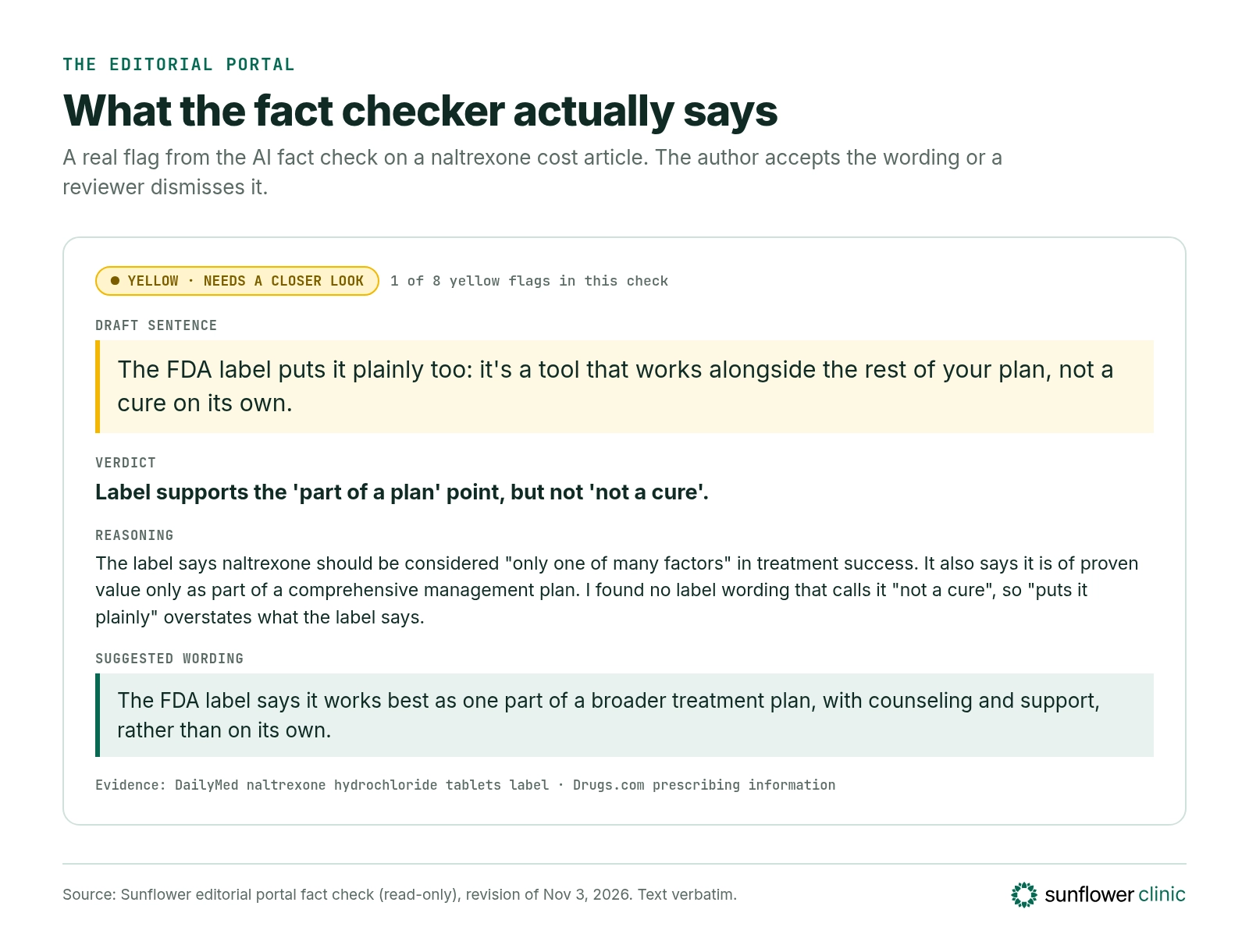
A real yellow flag from the AI fact check, verbatim.
We're on pace for 80+ articles a month. A few recent ones:
- How much naltrexone costs, with and without insurance
- How to get naltrexone online
- Could brenipatide, a new GIP/GLP-1 therapy, transform addiction and psychiatric care?
Agents also recruit doctors on hiring platforms, send writers feedback to level them up, make infographics for their articles, and can even pay them.
What I didn't see coming was where the bottleneck would move. Once agents owned the checks, the slowest step in the pipeline was a human clicking publish. So now the editorial agent publishes as soon as the author signs off. In November, the median time from a clinician hitting submit to the article being live was 3.5 minutes, and most articles were live within 15 minutes.
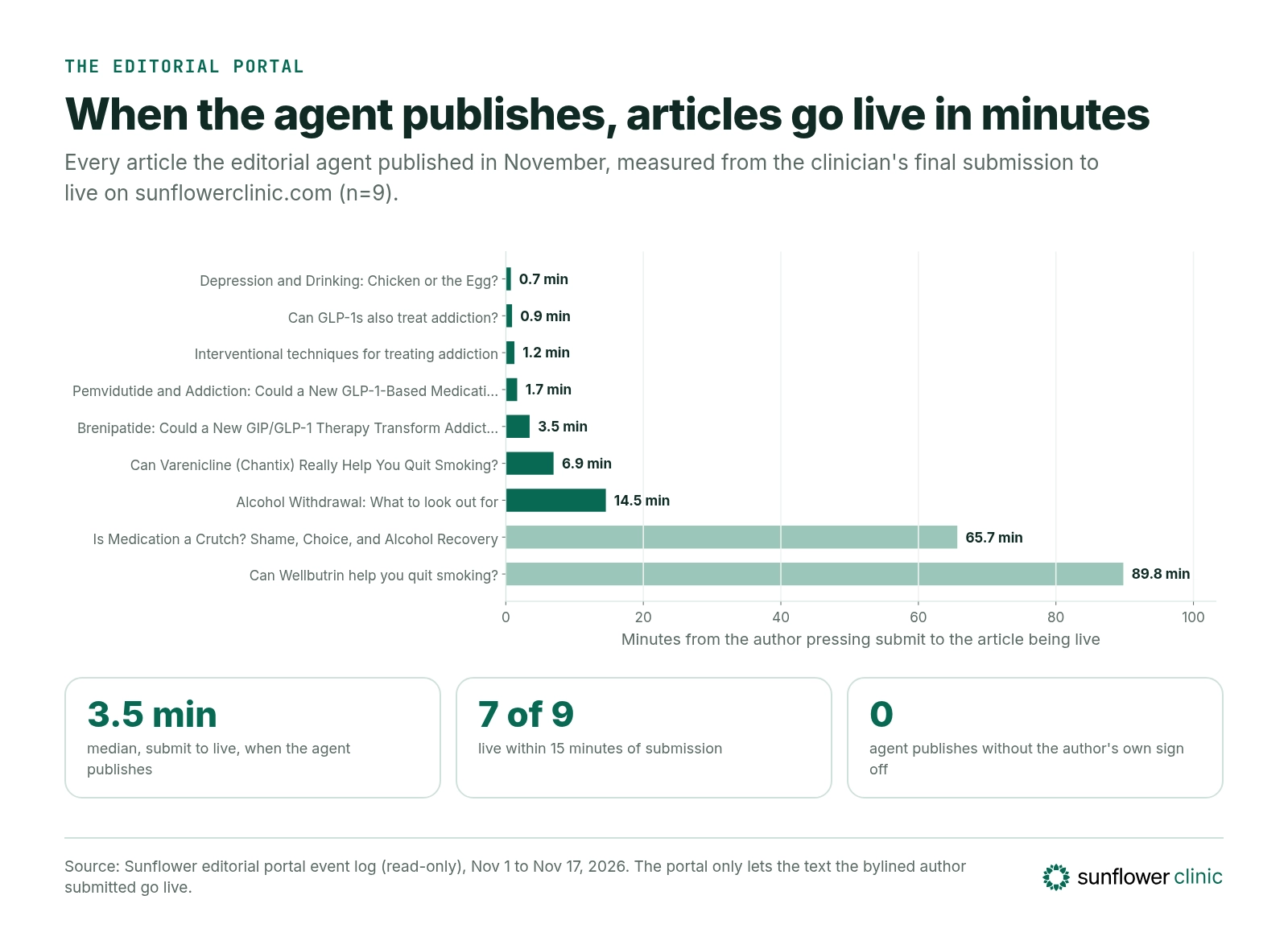
Minutes from author submission to live, for every article the agent published in November 2026.
Another agent owns the internal platform. Every day he watches PostHog session replays, reads Slack and email, and files a ticket when he spots a bug. Once a week he pitches new features, and a human approves or kills each one. Every pitch has to name the goal it moves: articles shipped per week, article quality, portal usability, search traffic and backlinks, or brand lift. No goal, dead pitch.
We also make the agents show their work. When a coding agent shipped a design refresh to the clinic site, Lucius diffed the before-and-after text of every page on desktop and mobile, down to the meta tags, structured data, and llms.txt.
Patient success: AI agents first, humans in the loop
For a healthcare startup, every dollar burned on operations is a dollar that doesn't go toward a higher standard of care. That's exactly why patient success was one of the first places we put agents.
The agents are there so struggling patients don't slip through the cracks. Messages get answered faster. Providers and support staff start from a strong first draft instead of a blank box. And we run quality control on every single message, where we used to spot-check a handful a week.
A human still reviews every patient success message and presses send. That's on purpose. These are people working on their sobriety, and some of them are having a really hard week. It's the same thinking behind our clinical safety process, where a licensed clinician reviews a patient's health history before anything is prescribed.
The agents have picked up that instinct too. When someone on the team asked Lucius to start forwarding my inbox every hour, he pushed back: "forwarding Koby's inbox hourly is a big access change, so I need his go-ahead before I set that up." That's exactly the judgment you want from an agent anywhere near patient comms.
Once patient success runs through agents, you can eval it the same way you eval the agents themselves. Response time, quality, tone, and whether the patient actually got what they needed all become numbers we track week over week.
Online medication and therapy for sobriety only works if people keep taking their meds and keep showing up. Keeping them showing up is the job we gave the agents. 🌻
Koby Conrad is the Founder and CEO of Sunflower Clinic. Find him on LinkedIn and X.
Want to give your agents their own email address, phone number, and iMessage, like James and Lucius? Get started in minutes or reach out to hello@inkbox.ai.